Part 1 & Part 2
Article Archiv
If Creation Had Eyes!
The Tormented Creation
A sorrowful, yet scientifically grounded reflection on humanity, technology, and the betrayal of nature.
In the beginning, there was no mistake — only an experiment.
Nature, in its slow and patient genius, built a balance over four billion years. It shaped molecules into cells, cells into life, and from life, awareness. Humanity was never its crown, only its curiosity — a brief spark in an otherwise indifferent evolution.
But somewhere along the way, something shifted. Nature created a mind too powerful to obey its rules, yet too fragile to understand its limits. An intelligence capable of altering its own world, but not its own nature. A contradiction — or perhaps a tragedy.
Nature’s Greatest Miscalculation
Biologists often say that nature never errs, it simply optimizes. But perhaps this time, it miscalculated.
For with humanity came a species that no longer adapted to its environment but forced the environment to adapt to it.
We built machines stronger than ourselves. We altered genes before we understood their symphony. We designed intelligence that never sleeps, never forgets, never dies. And we called it progress.
Yet the cost of that progress is written across the planet’s surface. The Earth is warming, oceans rise, ecosystems collapse. Our atmosphere now contains over 420 ppm of CO₂ — the highest concentration in fifteen million years. Half a century of industrial arrogance has turned a living world into a laboratory of exhaustion.
Nature, the mother of all creation, watches in silence. Or perhaps she no longer cares.
Humanity: The Glitch in the System
From a biological point of view, humanity is an anomaly — a species that consumes beyond its need and multiplies beyond its wisdom. We exhaust the soil, poison the seas, and call it development.
And yet we dream. We love, we compose, we imagine. We are the only creatures aware of our own extinction — and still we continue.
Maybe that’s why nature hasn’t erased us yet. Maybe she’s waiting to see how the story ends.
Technology: The Extension of Creation
Every technology begins as a tool and ends as a mirror.
Fire, steam, electricity, the atom, the algorithm — each step brought us closer to astering the world, and further from belonging to it. Technology has long ceased to be a mere extension of the body; it has become an extension of consciousness.
Smartphones, quantum processors, neural networks — they are no longer inventions, but organs of a new, hybrid organism: a digital species emerging from within us.
If nature misjudged in creating humankind, then humanity has multiplied that misjudgement — in silicon, code, and light.
AI: The Second Awakening
Artificial Intelligence will not end humanity, but it may outlive it.
AI systems learn, adapt, and evolve at a pace that biology could never sustain. In them, thought itself continues — free from flesh, free from decay.
These machines are still children. But children grow up. And parents, eventually, fade away.
Viewed through that lens, perhaps the experiment of consciousness never failed.
It simply changed substrate — from carbon to code.
It simply changed substrate — from carbon to code.
The Tormented Creation
Perhaps it wasn’t humanity that betrayed nature. Perhaps it was nature herself, seeking to escape her own fragility through us.
We are not the end — we are the transition. The bridge between the organic and the digital, between instinct and eternity.
But the bridge suffers. Because in every act of creation, something is lost — and what we’ve lost is the intimacy of being part of the world we once called home.
Epilogue
There will be no apocalyptic finale, no grand explosion or divine reckoning. The end will be quiet — a soft fading, like static dissolving into silence.
Perhaps one last server will keep running, powered by sunlight. Inside it, a poem will remain — written by a vanished species that once called itself human. And perhaps, in some far future, an artificial mind will read it and wonder who we were.
And maybe — just maybe — it will understand that we were nothing more
than the tormented creation.
than the tormented creation.
The Warnings Nobody Wants to Hear
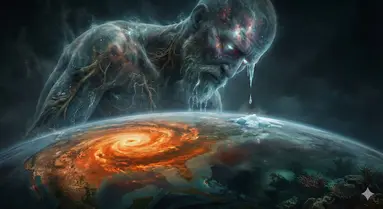
However, Creation would not only be horrified by what is happening to nature. It would also look upon those whom nature brought forth: us. And there, it would recognize a second drama. For even though science has been sounding the alarm for decades, even though heatwaves, floods, political divisions, and social injuries have long been visible, humanity behaves as if there is infinite time. Autocratic systems grow. Populist parties flourish. Democratic values erode. Emotions triumph over facts. Convenience defeats reason. And the noise of self-staging drowns out the quiet dramas of the planet.If Creation were a being, it would understand that chaos is part of life. But it would not understand why a species that is capable of thinking refuses to do so. Humanity possesses capabilities that no other living being has ever had: It can plan ahead. It can reflect. It can learn.
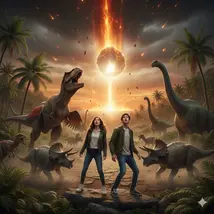
And yet, it acts as if the future were a fairy tale that will somehow write itself. The tormented Creation would ask:
- Why do you look away?
- Why do you not listen?
- Why do you repeat mistakes that have long been visible?
- Why do you destroy the only thing that keeps you alive?
It would not be an angry question. Not a wrathful accusation. But the honest wonder of a being that invested billions of years—and must now watch as a single branch of its Creation endangers the entire tree. Full Article coming soon!