
Welcome to the Safe Science-Fiction Website of Barry Redhead
You are visiting the safe science-fiction website www.Things-to.com of Barry Redhead. Concept & Storytelling by Barry Redhead. Refined through AI-supported editorial work for a polished reading experience.
Welcome to www.Things-to.com, the safe science-fiction website of Barry Redhead — a place for speculative futures, cinematic storytelling, uncomfortable questions, and visions of tomorrow that often feel dangerously close to today. Here you’ll find science-fiction short stories, future concepts, speculative worlds, book recommendations, essays, articles, and reading tips about artificial intelligence, space exploration, technological evolution, human–machine boundaries, and the political as well as emotional consequences of a rapidly changing world. This is a website for readers who are not only looking for escape, but also for reflection. Science fiction is more than distant stars and impossible machines. It is a mirror. A warning signal. A thought experiment. Sometimes, it is also the last honest way to speak about the present.
Klicken sie HIER für die deutsche Webseite REDHEAD.DE. oder klicken sie auf die Flagge oben!
Discover More Science Fiction by Barry Redhead
Science-fiction readers can explore more of Barry Redhead’s expanding creative universe across his connected websites. Discover English-language SF short stories, international book editions, artificial intelligence, alien civilisations, distant worlds, cinematic projects and thought-provoking visions of humanity’s future.Barry Redhead – Author Website >>> Learn more about British-German author and filmmaker Barry Redhead, his creative background and his work combining literature, filmmaking and speculative visions of the future.
Redhead Future Fiction – English SF Short Stories >>> Discover science-fiction short stories published in English. These cinematic stories explore artificial intelligence, aliens, apocalyptic futures, strange technologies and the uncertain destiny of humanity. Many of the stories are also available in German on the German SF Shorts website. Enter the world of Redhead Future Fiction and discover stories designed not only to entertain, but also to ask what humanity may become in a future shaped by technology, evolution and the unknown.
From Mars Probes to the IDEFIX Rover:
How Autonomous Space Robotics Mirror Our Own "Paradise 4.0"
For well over half a century, humanity has been conducting a quiet, relentless invasion of the Martian system. Yet not a single human footprint graces the rust-coloured regolith of the Red Planet. Instead, from the pioneering Viking landers of the 1970s to NASA’s nuclear-powered Curiosity and Perseverance rovers, Mars has become the exclusive domain of our mechanical proxies.
Now, the next chapter of interplanetary exploration is unfolding—not on the Martian plains themselves, but on its mysterious, cratered moon, Phobos. Powered by Japan’s heavy-lift H3 rocket as part of the JAXA Martian Moons eXploration (MMX) mission, a compact Franco-German rover named IDEFIX is set to tackle one of the most bizarre environments in our solar system.
As a science fiction author and filmmaker who has spent five decades analysing both the hard physics of spaceflight and the psychology of technological progress, I find missions like MMX deeply revealing. They show us not only where engineering is heading, but also hold up a stark mirror to the hyper-controlled digital society we are constructing right here on Earth—a concept at the very heart of my dystopian series, Paradise 4.0 (Paradies 4.0).
Engineering on the Edge: The MMX Mission and the IDEFIX Rover
While popular culture remains fixated on the romantic—and scientifically perilous—notion of sending human colonists on one-way trips to Mars, space agencies are focusing on hard pragmatism. Entering and leaving Mars’s gravity well requires colossal amounts of fuel. Its moons, Phobos and Deimos, however, offer low-gravity staging grounds that could serve as natural orbital outposts—provided we understand what they are actually made of.
That is where IDEFIX comes in. Developed jointly by the German Aerospace Center (DLR) and the French space agency (CNES), this 25-kilogram technological marvel is far more than a miniature car.
Mission Brief: The IDEFIX Rover at a Glance
- Mission Architecture: Part of the JAXA MMX (Martian Moons eXploration) sample-return mission, launched aboard the Japanese H3 rocket.
- Target Destination: Phobos, the larger and innermost moon of Mars.
- The Gravity Problem: Gravitational pull on Phobos is roughly 1/1000th of Earth's. A conventional rover would simply bounce off into space if its wheels spun too fast.
- Autonomous Upright System: Dropped from the main spacecraft from an altitude of around 40 to 100 metres, IDEFIX tumbles onto the surface and uses four independently articulated legs to right itself automatically.
- Core Objective: To act as a mechanical scout, analysing the surface properties and regolith mechanics before the main MMX spacecraft touches down to collect samples for return to Earth.
- The Illusion of Utopia: In Paradise 4.0, scarcity, crime, and chaos have been eradicated. The system provides everything—provided you comply with the telemetry.
- The Loss of Agency: Just as IDEFIX operates within pre-programmed boundaries, citizens in a perfected technological utopia trade genuine free will for algorithmic security—a theme further dissected in The Cage of Consciousness
- The Blurring Line: In Hybrid, Alien, Machine , the boundary between the biological creator and the autonomous machine dissolves entirely.
- Dive deeper into the thin line between technological progress and dystopian reality right here on [things-to.com]
- Discover the original German editions of Paradise 4.0 and YESTERDAY,TOMORROW WAS ALREADY DIFFERENT on this Website
Because radio signals between Earth and the Martian system suffer delays of up to 20 minutes each way, no human engineer in Cologne, Toulouse, or Tsukuba can steer IDEFIX with a joystick in real time. Once deployed, the rover must rely heavily on onboard autonomy to navigate freezing temperatures, sharp radiation, and micro-gravity dust.
When the Algorithm Takes the Wheel: From Space Probes to "Paradise 4.0"
This shift toward total machine autonomy is a triumph for aerospace engineering. In deep space, human hesitation is a liability; algorithmic precision is survival. Yet what happens when we apply that exact same engineering philosophy to human civilisation on Earth? Look around at our rapidly evolving digital infrastructure. In the name of safety, efficiency, and convenience, we are steadily removing human unpredictability from the equation. Smart cities, predictive policing, automated resource allocation, and behavioural algorithms are transforming our daily lives into a closed-loop system—not unlike the life-support and navigation subroutines of an interplanetary probe.
In my novel series Paradise 4.0 and works under the REDHEAD FUTURE FICTION banner, I explore the ultimate logical conclusion of this trend. Imagine a near-future society designed by minds that view humanity the way mission control views a rover on Phobos: as an asset to be protected, optimised, and kept strictly within safe operational parameters.
Hard Science Fiction: Why Realism Matters More Than Fantasy
Good speculative fiction does not need magical warp drives or laser swords. The real tension lies in extrapolating today’s tangible technologies—like the carbon-fibre legs of the IDEFIX rover or the thrust of Japan’s H3 rocket—into tomorrow’s existential dilemmas.
When I visualise scenes for my books or develop animated film adaptations using 3D tools like Reallusion iClone 8, I always return to the cold authenticity of real-world engineering. A tiny robotic scout righting itself in the silent, micro-gravity dust of Phobos while the colossal red sphere of Mars looms overhead is more dramatic than any fantasy. It reminds us of our brilliance as toolmakers—and our fragility as biological creatures. Our machines are conquering the solar system with cold, tireless perfection. The question we must answer back on Earth is simple: As we build our own digital Paradise 4.0, are we designing a launchpad for human potential, or the most comfortable cage in history?
Explore the Worlds of Barry Redhead
- Dive deeper into the thin line between technological progress and dystopian reality right here on [things-to.com] (Anchor: Explore Future Tech & Speculative Fiction).
- Discover the original German editions of Paradise 4.0 and YESTERDAY, TOMORROW WAS ALREADY DIFFERENT is on www.Paradies40.de/UK-english
- Read background dossiers on societal shifts and digital utopias at [paradies40.de]
What You’ll Find on This Website
Things-to.com is the English-language website of science-fiction author, filmmaker and visual storyteller Barry Redhead. The site offers insight into a growing universe of speculative fiction, future-oriented essays, literary updates and cinematic science-fiction concepts. Here, readers will find news, articles, background material and reflections on Barry Redhead’s creative work — including the science-fiction short story series "Yesterday, Tomorrow Was Already Different", the dystopian future universe Paradise 4.0, and its related prequel 43/53. But Things-to.com is more than a project archive. It is a place for questions that define our age: artificial intelligence, alien contact, machine consciousness, political instability, ecological collapse, inequality, war, space exploration and the uncertain future of humankind.
Should billions be spent on Moon and Mars missions while Earth struggles with hunger, conflict and environmental destruction? What happens when machines begin to dream? And what remains of humanity when technology no longer serves us, but begins to judge, imitate or replace us? These are not abstract questions. They are the raw material of our future. In the Articles section, Things-to.com publishes lead essays, commentaries and reflections on science fiction, society, technology, politics and the fragile architecture of tomorrow. Some older but still highly relevant articles remain available for several weeks after publication — because on this website, older does not automatically mean outdated.
The future does not shine. It flickers.
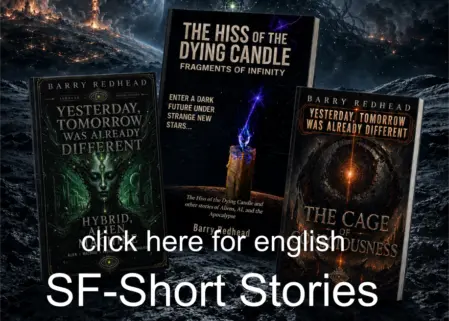
In Barry Redhead’s science-fiction short story series "Yesterday, Tomorrow Was Already Different", the journey leads from the dirty streets of Neo-Tokyo to the silence of the Singularity. Tomorrow smells of ozone, rusted titanium and synthetic sandalwood — and behind every technological vision waits the ancient question: what remains of humanity when machines begin to dream? The stories blend cyberpunk noir, AI satire, alien contact, dystopian futures, machine consciousness and cosmic wonder into a cinematic journey through possible tomorrows. Written for readers who love the atmosphere of Blade Runner, the unsettling questions of Black Mirror, and the philosophical depth of classic science fiction, the series offers short, intense visions of futures that feel strange, dangerous and disturbingly close.
Volume 1 "The Hiss of the dying Candle" available exclusively from Amazon.
Volume 2 – "The Cage of Consciousness " is now available worldwide — in every bookstore, everywhere in the universe.
Volume 3 the journey continues with "Hybrid, Alien, Machine" available internationally through booksellers and online bookstores.
This new collection explores artificial intelligence, alien contact, machine consciousness and the fragile border between human, hybrid and machine. Cinematic, atmospheric and thought-provoking, Hybrid, Alien, Machine continues the journey into futures where nothing remains quite as human as it once seemed. Barrys visions of tomorrow. One warning: Yesterday, tomorrow was already different.
The stars are silent.
The machines are dreaming.
But we are still here.
The machines are dreaming.
But we are still here.

A wonderful review of my second science-fiction short story collection, “The Cage of Consciousness,” is now available on Instagram at @reads.ashley. Ashley explores the book’s themes of artificial intelligence, consciousness, responsibility and machine ethics. Many thanks for this thoughtful and detailed review. Visit her Instagram page and read the full review at @reads.ashley.
Click LINK: click the Picture to READS.ASHLEYS Instagramm acount!
Click the PIC for watching the CLIP!
Discover Redhead Future Fiction – Barry Redhead’s creative future universe of science fiction, AI thrillers, dystopian visions, film ideas and international book projects. Literature, film, artificial intelligence, alien worlds and socially critical questions about the future come together here in a growing narrative cosmos. Find out more about current and upcoming projects, books, series and visual concepts on the Redhead Future Fiction website. Click on the logo or HERE to go directly to the page.
In the Work in Progress section, you can follow the current status of upcoming book projects, new stories, developing concepts, and future publications. This is where readers can see what is being written, expanded, revised, or prepared behind the scenes. In the SF Short Stories section, selected science-fiction stories are available to read directly on the website. These stories range from dystopian and philosophical to satirical, cosmic, political, and deeply human — always with one eye on the cracks in our civilization. You’ll also find book recommendations and reading tips for fans of intelligent, thought-provoking science fiction — stories that explore artificial intelligence, alien worlds, digital consciousness, future societies, space colonization, and the fragile line between progress and catastrophe.
Here you’ll find regularly published SF short stories, insights into developing fictional universes, background articles on futuristic technologies, and thought experiments about humanity’s possible futures. The focus goes beyond spectacle, it’s about impact: How does technology reshape power? What remains of humanity in an optimized world? Can progress exist without moral cost? This site combines classic science fiction themes, space, advanced technology, alternative societies, with a grounded, contemporary perspective. The futures explored here are not distant fantasies; they are extensions of changes already underway. You can find more science fiction short stories in the SF Shorts section.

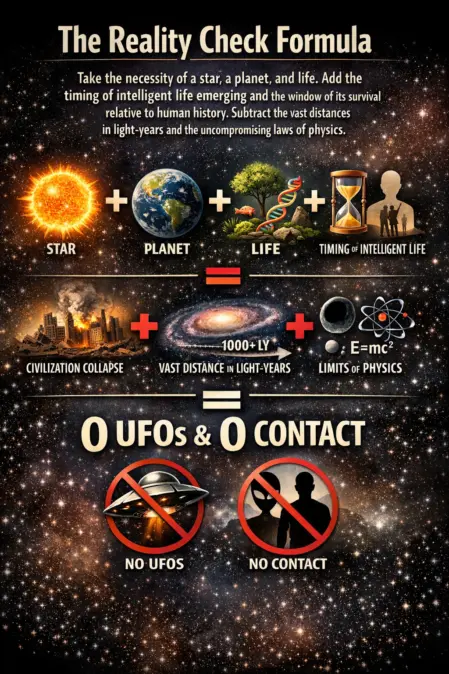
Click the PIC to more Information and the FILM-CLIP. UFOs YES or NO?
Why We Are Alone: The Physical Impossibility of First Contact Text: Forget what science fiction told you. This film deconstructs the UFO myth through the lens of astrophysics. From the immutable speed of light to the entropy of deep time, we analyze why interstellar visitation is scientifically ruled out. A sober look at the universe that explains why, effectively, we are alone in the dark.
"Related Links: We have curated some external websites for you. Simply click the buttons below to be redirected to these additional resources."
To my new Website about my AI thrillers Codename: Darwin — a dark, cinematic story about artificial intelligence, control, power and dangerous secrets. Click on the image to find out more about Codename: Darwin. Now the next AI-Thriller from the Darwin series is available. Charley - The Evidence lies.






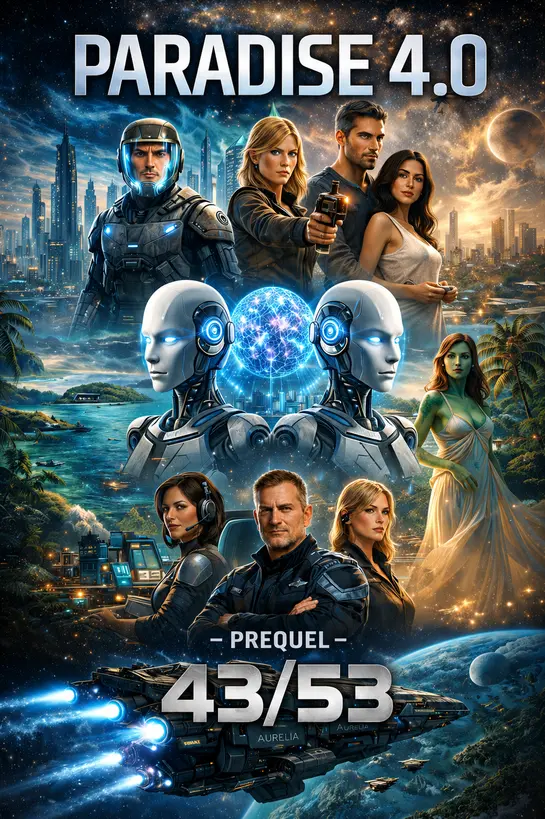
Welcome to the Worlds of Paradise 4.0 and 43/53!
On the website www.Paradies40.de, we gradually open the archives of the planet Hope and its many colonies. In the sections “Worlds” and “Colonies,” you will find detailed descriptions of ecosystems, settlements, political structures, and environmental conditions within the Paradise-4.0 universe. These articles are part of the ongoing development of the Paradise 4.0 novel series and will be expanded continuously as new chapters and background materials are completed. Many texts are already available in English, making the site accessible to international readers. Visit: 👉 www.Paradies40.de – sections Worlds & Colonies - Now Online- Planet Earth. Here, the complete universe of Paradise 4.0 grows step by step. Enter the future. Discover new worlds. Experience the paradise—its light and its darkness. The Books are coming in 2027. Stay Tuned!
For the MAJO - Marie-Josephine Youtube Channel and her great songs and videos, please click the picture. Three songs you can also hear on Spotify and other music cahnnels. Be sure to listen. Click her to her newest Song
