
Science-Fiction or Fantasy?
Main Article
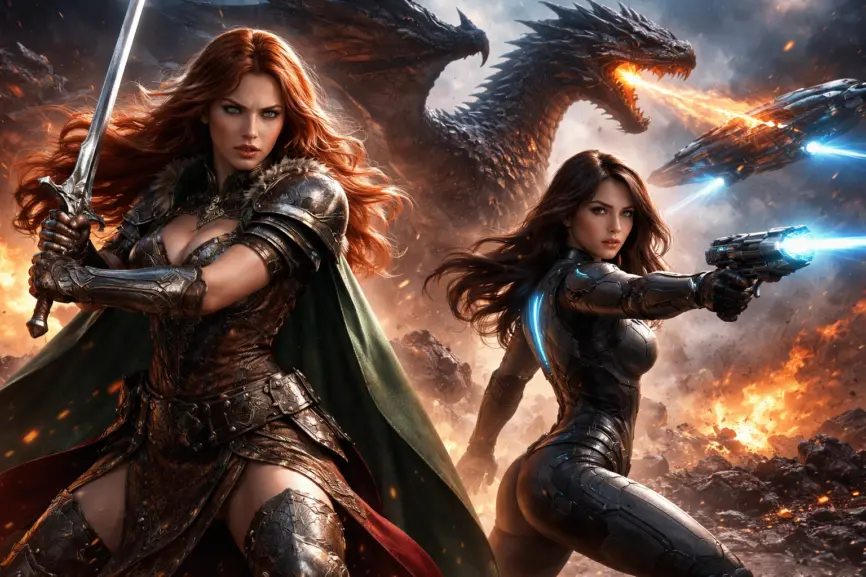
Science Fiction or Fantasy? Why Science Fiction Tells the Future Differently
When people talk about dragons, magic, distant kingdoms, and mythical heroes, they almost automatically arrive at fantasy. But when the conversation turns to artificial intelligence, space travel, state power, surveillance, biotechnology, or the collapse of entire civilizations, it enters the realm of science fiction. Both genres create other worlds. Yet they do so in fundamentally different ways. The key difference is not only the setting, but the logic behind it: fantasy is free to treat the impossible as a given, while science fiction asks what our world might become if science, technology, politics, and society continue to develop in a certain direction. That is precisely where its special power lies.
Fantasy usually works with magic, myth, fate, prophecy, and supernatural order. Science fiction, by contrast, tends to anchor its wonders in scientific or technological plausibility. Even when it leaps far into the future, it usually tries to make its ideas at least thinkable, deriving them from current research, present conflicts, and contemporary desires. That is what makes science fiction distinct. It does not simply invent worlds for the sake of wonder. It builds futures that feel possible.
There are differences in readership as well, though this point needs nuance. The often-repeated claim that “men read science fiction and women read fantasy” is too simplistic. The more reliable data suggest a more differentiated picture. Women generally read books more frequently than men overall. At the same time, science fiction still shows a noticeable male skew compared with many other fiction categories, while fantasy has become much broader and more diverse in its audience. In recent years, especially, fantasy has seen major growth in female-driven reading communities, particularly where the genre overlaps with romance, emotional worldbuilding, and strong social media engagement. So yes, science fiction still tends to have a stronger male readership than many neighbouring genres. But it is equally true that women read fiction in very large numbers overall, and that fantasy has become one of the most dynamic and broadly embraced genres in today’s market.
This is exactly where the deeper distinction between science fiction and fantasy becomes visible. No one can see the future. Science fiction does not pretend otherwise. Its real method is extrapolation. It takes political developments, social tensions, scientific breakthroughs, and technological trends from the present and pushes them forward. That is why science fiction is uniquely suited to creating plausible theories about tomorrow. It can imagine how our world might look if current tendencies continue, accelerate, or spiral out of control.
That makes science fiction far more than escapism. It is a laboratory of possibilities. It does not only ask, “What if?” It asks, “What happens to us if this development becomes real?” What happens to freedom when total connectivity becomes total control? What happens to democracy when data power becomes more important than elections? What happens to human relationships when machines can imitate emotion? And what happens to the very idea of being human when biotechnology, robotics, and space colonization begin to shift our limits? Science fiction is powerful because it does not use the future merely as decoration. It uses the future as a testing ground for the present.
A look at the great authors of the genre makes this especially clear.
Ray Bradbury did not build cold technological showcases. He built poetic warning systems. Fahrenheit 451 imagines a future society in which books are banned, turning the novel into a powerful meditation on censorship, anti-intellectualism, and the erosion of culture by mass media. In The Martian Chronicles, the settlement of Mars becomes an allegory of colonialism, cultural destruction, loneliness, and fear of the Other. Bradbury did not simply write “about the future.” He wrote about the anxieties of his own age under the light of tomorrow.
A look at the great authors of the genre makes this especially clear.
Ray Bradbury did not build cold technological showcases. He built poetic warning systems. Fahrenheit 451 imagines a future society in which books are banned, turning the novel into a powerful meditation on censorship, anti-intellectualism, and the erosion of culture by mass media. In The Martian Chronicles, the settlement of Mars becomes an allegory of colonialism, cultural destruction, loneliness, and fear of the Other. Bradbury did not simply write “about the future.” He wrote about the anxieties of his own age under the light of tomorrow.
Brian Aldiss stood for a form of science fiction that did not merely invent worlds, but thought them through biologically, historically, and civilization ally. In his Helliconia trilogy, he created a planet shaped by immense climatic cycles, where religion, power, evolution, and culture are intertwined. Aldiss emphasized that such work was not fantasy, but a form of scientific romance, because the world had internal lawfulness, natural process, and a coherent developmental logic. His stage was vast, but it remained tied to environment, social structure, and long-term history.
Harlan Ellison pushed science fiction into a more psychological, aggressive, and morally charged space. In stories such as “Repent, Harlequin!” Said the Ticktockman and I Have No Mouth, and I Must Scream, the future becomes a pressure chamber in which systems of control, violence, time discipline, and technological extremity reveal what remains of the human being when dignity and freedom are crushed. Ellison showed that science fiction does not need to be about gadgets and machines alone. It can also be about fear, conscience, cruelty, and the struggle to preserve human identity under unbearable pressure.
Arthur C. Clarke represents perhaps better than anyone else the union of scientific plausibility and metaphysical grandeur. Long before communication satellites became reality, Clarke described such a system in theoretical terms. In 2001: A Space Odyssey, space travel, artificial intelligence, alien intelligence, and human evolution come together in a vision that is both technically disciplined and philosophically immense. Clarke demonstrates a central principle of science fiction: wonder does not have to arise from magic. It can arise from the disciplined imagination of what science and cosmic perspective might do to humanity.
Isaac Asimov, finally, turned the future into a system. His famous Three Laws of Robotics became one of the defining reference points for all later debates about machine ethics. But even more significant is the Foundation series, in which Asimov imagines “psychohistory,” a science capable of predicting the large-scale behaviour of societies. In that vision, the collapse of a galactic empire is not simply an adventure backdrop. It becomes a study of power, probability, history, knowledge, and civilizational crisis. Asimov’s future is not built around isolated heroes alone. It is built around structures, systems, and the immense question of whether reason can impose order on chaos. That so much science fiction is dystopian is therefore hardly surprising. Dystopias are the dark mirror image of progress narratives. They ask what happens when good ideas, powerful technologies, or political systems tip into catastrophe. Utopias often have a dramatic problem: perfection creates little conflict. Dystopias, by contrast, thrive on tension. They transform today’s fears into concrete images: surveillance states, ecological collapse, algorithmic rule, dehumanization, engineered inequality, or the replacement of truth by manipulation.
Why, then, have so many science fiction authors written dystopias rather than ideal futures?
First, because warnings are dramatically stronger than harmony. Conflict drives narrative. Second, because dystopias translate diffuse cultural fears into visible and memorable forms. They give shape to anxieties about the future. Third, because they function as critique. Dystopian fiction is often not an escape from politics, but a direct confrontation with it. It warns, exaggerates, sharpens, and reveals. It allows readers to recognize dangerous tendencies before they become reality.
And yet it would be wrong to reduce science fiction to doom alone. The best science fiction is not merely pessimistic. It tests whether hope can survive under pressure. Bradbury defends memory and literature. Clarke expands humanity into the cosmos. Asimov searches for order within collapse. Aldiss ties destiny to ecology, history, and adaptation. Even Ellison, in all his darkness, ultimately writes about the fragile value of human dignity. Great science fiction is therefore never just “technology fiction.” It is literature of the future with a mission in the present.
Perhaps that is the most beautiful way to describe the genre: fantasy often offers us an escape from reality, while science fiction forces us to look at reality more sharply. It takes our political systems, our technical visions, our social hopes, and our cultural anxieties and projects them forward. Not as certain prophecy, but as credible possibility. That is why science fiction remains unique. It does not merely invent worlds. It examines what kind of world ours could become.
Science fiction therefore occupies a singular place in literature. It can be visionary without becoming naïve, critical without losing imagination, and speculative without abandoning human truth. It does not know the future, but it can read the signs of the present. And in doing so, it opens a space that few other genres can create: a space where politics, technology, ethics, society, and human longing converge in stories that ask not only where we are going, but what kind of people we may become along the way.