
Science Fiction from Mary Shelley to Today
Main Article
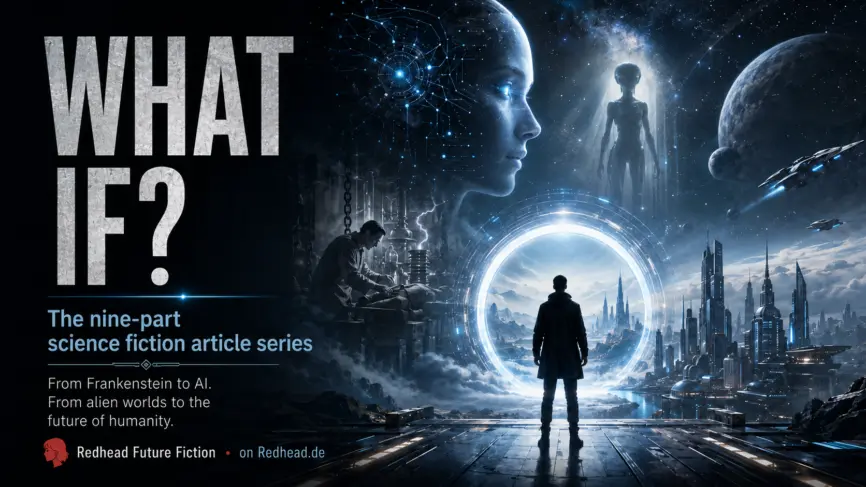
I ask a question older than every spaceship, every artificial intelligence and every alien world: What if?
- What if humankind creates life – and one day realises it can no longer control it?
- What if machines do not merely calculate, but think, doubt and dream?
- What if aliens do not arrive to destroy us, but to show us how little we truly understand ourselves?
Science fiction does not begin in outer space. It begins in the mind. From Mary Shelley’s Frankenstein to Jules Verne, H. G. Wells, Isaac Asimov, Arthur C. Clarke, Robert A. Heinlein, New Wave, cyberpunk and modern AI dystopias, this nine-part article series on Things-to.com explores the history of a literature that is far more than entertainment. Science fiction asks questions about power, responsibility, progress, fear and hope. It challenges systems, politics, blind faith in technology and the dangerous belief that everything we can do is automatically something we should do. Above all, it opens new spaces.
In the past, the question “What if?” may sound like a warning.
In the future, it may become a doorway.
Welcome to Things-to.com
Welcome to Redhead Future Fiction.
Welcome to the literature of possibilities.
Welcome to Redhead Future Fiction.
Welcome to the literature of possibilities.
Part 1 - Science Fiction Begins with “What If?” – From Mary Shelley to Frankenstein
What if?
What if human beings could create life? What if machines could think? What if alien intelligence did not conquer us, but misunderstood us? What if politics, capital, technology and fear built a future in which humanity became little more than a footnote?
That question is the true engine of science fiction. It opens doors that seem closed in the present. It takes an idea, a scientific possibility, a social development or a moral danger – and extends it into the future. There, under the pressure of imagination, the hidden structures of the present become visible.
The beginning of modern science fiction is often linked to Mary Shelley. In 1818, she published Frankenstein; or, The Modern Prometheus and created not only one of literature’s most famous creation myths, but also a foundational text of science fiction. Victor Frankenstein crosses a scientific boundary. He creates life. Yet the decisive question is not whether he can do it. The decisive question is whether he accepts responsibility for what he has made. That is why Frankenstein remains so powerful. It is not merely a story about a monster. It is a story about a creator who refuses moral responsibility for his creation. This motif still echoes through stories about genetic engineering, artificial intelligence, biotechnology and posthuman futures.
From the beginning, then, science fiction was more than technical fantasy. It was the literature of responsibility. It did not merely ask what could be done. It asked what price might be paid for doing it. It asked what happens when progress moves faster than ethics. And it placed humanity exactly where science fiction still loves to place it: at the threshold of a future it has created, but may no longer be able to control.
Part 2 - Science Fiction Begins with “What If?”
What if? From Jules Verne and H. G. Wells to Modern Science Fiction
After Shelley, Jules Verne and H. G. Wells opened two great doors for science fiction. Both looked towards the future, but they did so in very different ways. Jules Verne stood for technology, travel, discovery and scientific possibility. His novels showed a world in which inventions could move boundaries. Submarines, journeys to the Moon, expeditions beneath the Earth or around the world – in Verne, technology became adventure. Scientific curiosity became a narrative force. His future was often an extension of human ingenuity.
H. G. Wells, by contrast, looked at the future with a darker, sharper and more political eye. In The Time Machine, The War of the Worlds and The Island of Doctor Moreau, the future was not merely admired. It was interrogated. Wells was interested in evolution, class division, colonialism, war, power and the fragility of civilisation. His machines were not only wonders. They were instruments for examining the human condition. From that point onwards, science fiction became a literary experiment. It placed humanity inside laboratories: on alien planets, in distant centuries, under foreign rule, inside machine worlds, artificial paradises, ruined cities and political systems that feel disturbingly familiar.
The important point is this: science fiction appears to move away from reality in order to approach it more directly. It relocates conflicts into the future, onto other worlds or into alternative societies so that we can see them more clearly. An alien invasion can speak about imperialism. A time machine can expose social inequality. A remote island of experiments can reveal scientific arrogance. That is why science fiction is never merely an escape from reality. Very often, it is the most direct route back into the present. It does not only show what might come. It asks why it might come – and who would be responsible.
Part 3 - Science Fiction Begins with “What If?”
What if? The Golden Age and the Big Three of Science Fiction
In the twentieth century, science fiction became a mass phenomenon. Magazines, pulp fiction, paperbacks and, later, film and television made the genre visible across the world. Especially influential were the so-called Big Three: Isaac Asimov, Arthur C. Clarke and Robert A. Heinlein. Clarke, Asimov and Heinlein are still widely referred to as the “Big Three” of science fiction.
Asimov brought intellectual architecture to stories about robots, empires and the cycles of civilisation. His robot stories and famous laws of robotics turned machines into moral tests rather than simple monsters. Clarke connected cosmic scale with scientific elegance. In works such as Childhood’s End, Rendezvous with Rama and 2001: A Space Odyssey, humanity becomes small, but not meaningless. Heinlein wrote about freedom, militarism, social models, bodies, sexuality and political self-determination – often fascinating, often controversial, but always influential.
The Big Three gave science fiction a powerful structure: Asimov gave it logic, Clarke gave it the cosmos, Heinlein gave it the conflict between the individual and society.
Part 4 - Science Fiction Begins with “What If?”
Beyond the Big Three: The Great Voices of Classic Science Fiction & more
But the Golden Age was never theirs alone. Ray Bradbury brought poetry, melancholy and moral warning into the field. Ursula K. Le Guin opened science fiction to anthropology, gender, anarchism and radical social thought. Philip K. Dick asked whether reality itself was stable. Frank Herbert turned politics, religion, ecology and power into an epic future system with Dune. Stanisław Lem dissected knowledge, alienness and the limits of human understanding. Samuel R. Delany, Octavia E. Butler, James Tiptree Jr., Brian Aldiss, J. G. Ballard, Norman Spinrad, John Brunner, Harlan Ellison and many others expanded science fiction into questions of body, language, psychology, sexuality, media, racism, colonialism and systemic power.
New Wave: When the Future Exploded Inwards
In the 1960s and 1970s, the New Wave broke with many conventions of classical science fiction. The future no longer had to shine. It could be fragmented, psychological, political, psychedelic, erotic, disturbing and openly literary. The Encyclopedia of Science Fiction identifies Brian W. Aldiss and J. G. Ballard as early central writers whose work was later placed under the New Wave label. New Wave was less interested in perfect rockets than in damaged perception. Outer space was not the only alien territory; the human mind itself had become strange. J. G. Ballard relocated catastrophe into architecture, media, cars, bodies and psychology. Aldiss, Moorcock, Spinrad, Delany, Ellison and others opened the genre to stylistic disruption, sexuality, counterculture and political unrest.
For science fiction, this was decisive. The genre became fully adult. It no longer had to prove that it could be literature. It demonstrated it.
Cyberpunk: High Tech, Low Life
In the 1980s, Cyberpunk arrived. William Gibson, Bruce Sterling, Pat Cadigan, Rudy Rucker and others transformed computers, corporations, cities, data spaces and body modification into a new dark mythology. The Encyclopedia of Science Fiction explains that the term Cyberpunk was applied in the early 1980s to writers such as Bruce Sterling and William Gibson, and that Gibson’s Neuromancer in 1984 decisively shaped our understanding of the subgenre.
Cyberpunk was not only neon, rain and leather jackets. Cyberpunk was the recognition that the future does not automatically mean progress. In its strongest forms, it presents a world in which technology is highly advanced, yet human beings remain lonely, monitored, exploited and replaceable.
That made Cyberpunk one of the most lucid forms of political science fiction. It understood early that data means power. That corporations can overtake states. That identity can be edited. That machines do not need to rule if systems already do.
Part 5 - Science Fiction Begins with “What If?”
From Space Opera to Cli-Fi: Why Science Fiction Matters Today
Today, science fiction is no longer a single stream. It is a delta. Hard SF asks for scientific plausibility. Space Opera tells stories of empires, wars and cosmic myth. Dystopia investigates surveillance, fascism, climate collapse, biopolitics and social control. Cli-Fi and Eco-SF ask how the planet suffers under human action. Solarpunk attempts not merely to imagine collapse, but to design liveable ecological alternatives; the Encyclopedia of Science Fiction describes Solarpunk as a direction that has grown in popularity since the late 2000s.
Alongside these are Afrofuturism, feminist SF, postcolonial SF, Queer SF, Biopunk, Steampunk, Dieselpunk, Hopepunk, near-future thrillers, AI fiction and speculative novels that sit almost inside the present. Science fiction has not become smaller. It has expanded in every direction. Nor is it merely Western or English-language literature. Research into international science fiction shows that the genre is produced, read and discussed globally, across many languages and cultures.
Why Science Fiction Matters More Than Ever
The present has caught up with science fiction. Artificial intelligence, climate crisis, surveillance, deepfakes, algorithmic judgement, genetics, private space flight, resource wars, digital loneliness and political radicalisation are no longer remote motifs. They are daily reality. That is exactly why science fiction matters so much today. Not because it predicts the future with perfect accuracy. That was never its highest purpose. Its true power lies in building models of thought.
Science fiction does not ask: “What will happen?” It asks: “What could happen – and what does that reveal about us?” In that sense, science fiction is system-critical at its best. It shows how power works before power becomes invisible. It exposes technological faith before it hardens into religion. It makes political structures visible by dressing them in the costumes of the future. It can challenge capitalism, militarism, colonialism, racism, patriarchy, surveillance, bureaucracy and ideology without imitating a newspaper editorial.
Science fiction is the literary form that makes systems visible.
“What If?” – The Most Important Question in Science Fiction
The words “What if?” possess a double force. Applied to the past, they can be painful. What if one decision had been different? What if a war had been prevented? What if a love had remained, a power had been broken, a mistake had been recognised? The past does not answer. It is closed. In that direction, “What if?” can quickly become regret, grief or despair. In science fiction, however, the question changes direction. It does not look backwards. It looks forwards.
- What if we lived differently?
- What if artificial intelligence were not merely a tool, but a mirror?
- What if aliens did not attack us, but revealed our own absurdity?
- What if a society without money, exploitation or fear were possible?
- What if the human being were not the end of evolution, but only a transition?
That is the great advantage of science fiction: it makes alternatives thinkable. It does not force us to accept the future. It shows that every future is a construction – political, technological, moral and cultural.
No other literary form can do this with the same radical force. Historical novels explain how things were. Contemporary fiction describes how things are. Fantasy creates mythic counter-worlds. But science fiction asks what things might become – and who would benefit.
Part 6 and 7 - Science Fiction Begins with “What If?”
Barry Redhead and Redhead Future Fiction in Tradition of Great Science Fiction
Barry Redhead’s own science-fiction work stands within this tradition. As an author, filmmaker, cameraman and creator of visionary material, Redhead Future Fiction connects literary futures with cinematic thinking. The stories are not born only from ideas, but from images: rain-dark cities, artificial consciousness, collapsing systems, aliens, AI figures, political nightmares and moral borderlands.
Barry Redhead’s projects – including Paradies 4.0, Yesterday, Tomorrow Was Already Different, The Hiss of the Dying Candle, The Cage of Consciousness, CODENAME: DARWIN and other future narratives – move precisely where science fiction is strongest: between warning and possibility.
Redhead’s work does not merely ask what technology can do. It asks whom technology serves. It is interested in artificial intelligence, but not as a toy. In aliens, but not merely as monsters. In the future, but not as decorative scenery. At the centre remains the human being: vulnerable, contradictory, curious, dangerous, replaceable – and perhaps still redeemable.
In SEO terms, this work can be positioned clearly: Barry Redhead writes cinematic science fiction, AI thrillers, dystopian future stories and speculative literature about consciousness, power, machine ethics, alien contact and the future of humanity. Redhead Future Fiction is not a single book project, but a growing creative universe of novels, short stories, film ideas, visual concepts and international publications.
Analysis: Barry Redhead’s SF in Relation to Major Writers
When Barry Redhead’s science fiction is compared with the great lines of the genre, an interesting mixture appears. From Mary Shelley, it takes the central question of responsibility: what happens when humanity creates something it can no longer morally control? From Asimov, it shares an interest in robotics, AI, system logic and ethical machine questions. From Clarke, it draws the fascination with wide horizons, cosmic perspective and technological vision. From Heinlein, it touches the question of how individuals act inside political and social systems. Its closeness to Philip K. Dick lies in the instability of reality: what is human, what is simulation, what is manipulation, what is consciousness?
Its closeness to J. G. Ballard lies in the attention to inner catastrophes, psychological spaces and civilisational fractures. From Norman Spinrad and the New Wave, one can recognise a taste for system criticism, satire and boundary-crossing. In relation to William Gibson and Cyberpunk, Redhead’s work shows a clear interest in AI, data power, corporate control, digital surveillance and the future as a present that has already begun.
The difference lies in the cinematic approach. Many classic SF authors write primarily from a literary or scientific perspective. Barry Redhead visibly thinks in scenes, images, camera movement, posters, clips, character entrances and visual worlds. His science fiction is therefore not only a narrated future, but often already imagined cinema. That makes his work especially relevant to contemporary media: websites, book series, AI imagery, animation, trailer texts, film concepts and international editions. At a time when science fiction no longer exists only in books, but across screens, platforms, games, clips and AI-generated worlds, this combination of authorship and cinematic vision is a distinct advantage.
Conclusion: Science Fiction Is Not Escape. It Is an Early-Warning System.
Science fiction has never merely been the literature of the stars. It has always been the literature of consequences. From Mary Shelley to Cyberpunk, from Asimov to Le Guin, from Clarke to Butler, from Wells to Gibson, from New Wave to Solarpunk, science fiction has proved that it can do more than decorate the future. It can warn, seduce, disturb, comfort, provoke and reveal alternatives. Its most important question remains:
What if?
Not as nostalgic torment. Not as an escape from reality. But as a tool against the tyranny of inevitability. Because as long as a society can still ask what could be different, it is not lost. And as long as science fiction continues to ask that question, it remains one of the most political, system-critical and necessary literary forms of our time.
This article series ends here for now — but science fiction itself remains open.
Every future we imagine also tells us something about who we are today, what we fear, what we hope for, and what kind of world we may still choose to create.
Every future we imagine also tells us something about who we are today, what we fear, what we hope for, and what kind of world we may still choose to create.
Discover more science fiction by Barry Redhead: Explore Redhead Future Fiction, including books, short stories, AI thrillers, cinematic future worlds and speculative stories about alien contact, artificial intelligence, power and humanity.
The Series ENDS here!