
Moon Tec
Main Article
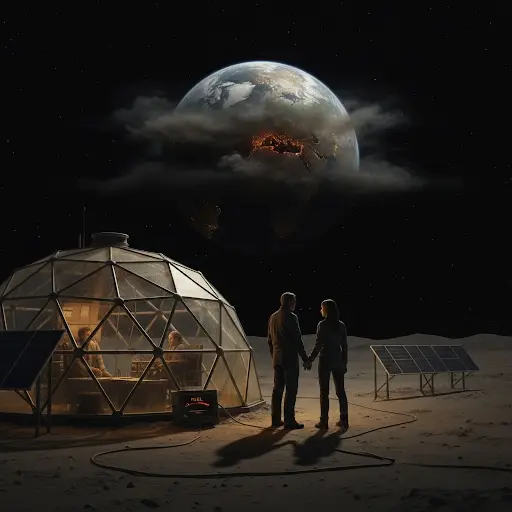
Five Moon Technologies That Once Belonged to Science Fiction – and Are Now Becoming Reality
The Moon is back. Not merely as a silver disc in the night sky, not simply as a nostalgic echo of Apollo, flags and grainy television images, but as a technological proving ground on the edge of human reach. The new race to the Moon is not a romantic rerun of the past. It is a stress test for the future. Under Artemis, NASA has shown that the return to deep-space human exploration is no longer just a speech, a poster or a political slogan. Artemis, I sent Orion around the Moon and safely back to Earth. Artemis II represents the next major step: human beings travelling once again beyond low Earth orbit. Yet Artemis also reveals the harder truth behind modern space exploration. Timelines slip. Missions are redesigned. Landings move further into the future. Systems become more complex, more expensive and more politically vulnerable.
Above all, one uncomfortable question remains: is the Moon truly a necessary stepping stone to Mars – or an extraordinarily costly detour? The answer is not simple. The Moon can be a training ground, a laboratory, a scientific destination and a geopolitical symbol. But it is not a cheap place. It is not an easy place. And it is not automatically the gateway to the Solar System. Its real value lies in what it forces us to prove: that future spaceflight can work technically, economically and strategically – not only beautifully in concept art.
1. Navigation That Can Think for Itself
In classic science fiction, spacecraft often land on alien worlds with effortless grace. In reality, every lunar landing is a high-risk operation. The Moon is covered with craters, boulders, slopes, shadows and treacherous terrain. Near the lunar south pole, where future missions are particularly interested in water ice, the lighting conditions can be harsh and deceptive. That is why future lunar landers need more than a programmed descent. They need autonomous navigation. Cameras, lidar, radar, image processing and artificial intelligence must work together to identify hazards, compare terrain with stored maps, calculate safe landing zones and react in real time.
In a sense, the Moon is demanding a new machine instinct. Not consciousness, of course, but a functional ability to read a landscape, judge danger and choose a better option without waiting for a human command from Earth. What is being developed for lunar landers could later matter on Earth as well: autonomous vehicles in difficult environments, disaster-response robots, drones in unmapped terrain, mining machines, rescue systems and vehicles operating where GPS is unreliable or unavailable.
2. Robots That Dig, Drill and Prepare the Ground
Before humans can stay on the Moon for longer periods, machines will have to do the heavy work. And on the Moon, heavy work begins with dust. Lunar regolith is fine, abrasive, clingy and potentially damaging to equipment. Yet it may also be one of the Moon’s most important resources. From regolith, future systems may be able to extract oxygen, metals, construction materials or components for solar-power infrastructure. What once sounded like industrial science fiction is now becoming a serious area of engineering research.
This is where the argument for a lunar base becomes interesting. A permanent presence on the Moon only begins to make sense if not every kilogram of material has to be launched from Earth. Space transport is expensive. Very expensive. If oxygen, water, building materials or energy components can eventually be produced locally, the economics of lunar operations could change. But the word “eventually” matters. A laboratory demonstration is not the same as a working lunar industry. A prototype is not a supply chain. A promising resource is not yet a functioning economy.
The next generation of lunar robots will therefore be more than tools. They will be accountants of the future. They will help answer whether lunar infrastructure is a practical step towards deep-space operations – or simply an elegant dream with an impossible price tag.
3. Power Systems for the Long Lunar Night
On the Moon, energy is not a convenience. It is survival. A lunar day lasts roughly 29.5 Earth days, which means long periods of sunlight in some places – and long, brutal nights in others. Temperatures can plunge dramatically. Batteries are strained. Systems must be kept warm. Instruments, habitats, rovers and communication networks all need reliable power. Solar energy will remain essential, especially in favourable areas near the lunar south pole. But solar power alone is not enough everywhere, and not at all times. That is why compact nuclear fission systems are moving closer to the centre of lunar planning. A small reactor could provide stable electricity for years, regardless of darkness, dust or extreme temperature swings.
This is fascinating engineering – and politically sensitive. Nuclear power on the Moon sounds like the future, but it also raises questions of safety, regulation, public trust and international responsibility. Still, the logic is clear. Without reliable energy, there is no lasting lunar presence. No research base. No industrial demonstration. No extensive rover operations. No meaningful human outpost. Power is the invisible foundation of every off-world settlement.
4. Communication Beyond Classic Radio
The Moon missions of the twentieth century belonged to the age of radio: crackling voices, brief commands, huge ground stations and heroic simplicity. The new lunar era needs something more complex. It needs networks. Astronauts, rovers, landers, instruments, cameras, autonomous systems and mission control centres must exchange data not occasionally, but continuously and flexibly. This is why lunar communication and navigation services are being developed in ways that increasingly resemble an internet for the Moon.
One of the most symbolic steps has been the demonstration of cellular technology on the lunar surface. 4G on the Moon sounds almost absurd, as though somebody had signed a mobile contract at the edge of civilisation. Yet this kind of technology could one day connect rovers, spacesuits, habitats, instruments and autonomous systems far more efficiently than traditional point-to-point radio alone. The Moon is not being wired for entertainment. It is being networked because complex operations require data: telemedicine, remote control, scientific measurements, safety warnings, navigation support, suit-to-rover communication and the coordination of missions from different nations and companies.
If the Moon becomes digitally connected, it will mark more than another step in space exploration. It will be the beginning of infrastructure beyond Earth.
5. Autonomous Systems That Work as a Team
The most important lunar technology may not be a single rover, a single reactor or a single communication system. It may be the ability of many systems to work together. Future missions will not consist only of astronauts and one vehicle. They may involve swarms of small machines, specialised robots, fixed sensors, flying scouts, autonomous landers, intelligent control systems and robotic construction equipment. These systems will need to exchange data, map terrain, set priorities and make limited decisions without constant help from Earth.
That autonomy matters because even the Moon is not close enough for every second to be managed by human hands. Communication delays, limited bandwidth, terrain shadows and operational risk all make local decision-making essential. Looking further ahead to Mars, the need becomes even greater. On Mars, real-time remote control from Earth is not practical. The Moon can therefore become a training ground for cooperative machine intelligence. Lessons learned there could shape future Mars missions – but also have applications on Earth: disaster response, deep-sea exploration, remote construction, climate monitoring, autonomous logistics and infrastructure maintenance in dangerous environments.
Is the Moon Really Useful as a Base for Further Spaceflight?
The great promise is clear: the Moon is a forward operating base for Mars. It allows engineers and astronauts to test technology, gain experience, study resources and learn how to live and work away from Earth. This argument is powerful. The Moon is only days away. Mars is months away. A serious failure on the Moon is dangerous; a serious failure on Mars may be final.
As a test site, the Moon makes sense.
As a true fuel depot, shipyard or gateway to the Solar System, however, the case is still unproven. Resource extraction, energy production, launch infrastructure, transport logistics and industrial processing would all have to work at a scale that does not yet exist. Water ice at the lunar south pole is important, but it is not yet a propellant economy. Regolith may be useful, but it is not yet a factory. A lunar base is a concept, not yet a functioning system. This is where honesty matters. The Moon is valuable if it accelerates technologies, reduces risk and creates capabilities that will be useful elsewhere. It becomes questionable if it is mainly treated as a prestige project whose cost rises faster than its practical benefit.
The Cost Problem: The Future Has a Price
Spaceflight has never been cheap. But Artemis exists in a very different world from Apollo. The United States is no longer operating in the same post-war moment of industrial confidence and seemingly limitless national expansion. America now carries a national debt of around 39 trillion dollars. At the same time, it must fund infrastructure, healthcare, defence, social security, education, climate resilience and interest payments on that debt.
In that context, every multi-billion-dollar lunar vision must be justified more rigorously than before. Not because space exploration is unimportant, but because future policy must remain credible. If governments plan Moon bases, they must explain the scientific, technological, economic and strategic returns – and why those returns justify the cost. The honest answer is this: some lunar technologies may become extremely valuable. Autonomous navigation, robotics, energy systems, communication networks and artificial intelligence under extreme conditions are key technologies. But a permanent Moon base only makes sense if it becomes more than a symbol. It must generate knowledge, build capability and deliver technological returns that matter beyond space exploration itself.
Why This Matters on Earth
The Moon is not a second home. It is cold, hostile, dusty and expensive. That is precisely why it is such a powerful test. Technologies that work there must be robust. Systems that save energy there may help improve efficiency on Earth. Robots that operate autonomously there may one day work in disaster zones. Communication networks built for extreme environments may help connect remote regions. Resource-use technologies developed for the Moon may inspire new industrial processes here at home.
The most important lesson may be this: the Moon is not fascinating because the future is waiting for us there. It is fascinating because it forces us to build the future under unforgiving conditions. Science fiction saw this long ago: intelligent machines, networked outposts, robotic workers, artificial intelligence, energy islands on hostile worlds. Now reality is slowly, expensively climbing towards that vision. Whether this becomes a new era of exploration or merely another chapter in costly geopolitical symbolism will not be decided by beautiful animations. It will be decided by engineering, cost, usefulness and honesty.
The Moon is back. But this time, reaching it is not enough. This time, we have to prove that staying there makes sense.